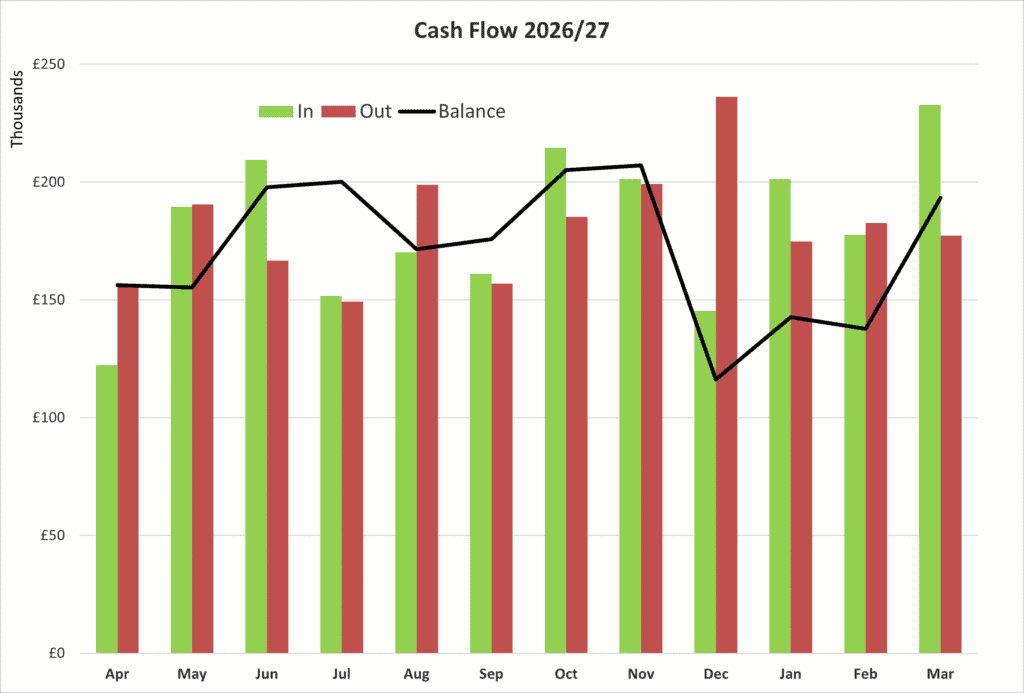
Understanding a Law Firm Cashflow Forecast is vital for ambitious law firm owners who want to understand not just profitability, but when cash is likely to come in and go out of the business.
A cashflow forecast helps answer a very practical question:
👉 Will we have enough cash to meet our commitments when they fall due?
That sounds simple.
But profit and cash are not the same thing.
A profitable law firm can still experience cashflow pressure if money is tied up in WIP, debtors or other commitments.
That is why cashflow forecasting is such an important part of financial management for growing law firms.
What Is a Law Firm Cashflow Forecast?
A Law Firm Cashflow Forecast estimates future cash inflows and outflows over a specific period.
Typical cash inflows might include:
✅ Profit Costs Received
✅ Aged Debts received
✅ Bank Interest
✅ Disbursement receipts
✅ Other business income
Cash outflows might include:
✅ Payroll
✅ Supplier payments
✅ Office costs
✅ Professional fees
✅ PII
✅ VAT
✅ PAYE and National Insurance
✅ Tax liabilities
✅ Loan repayments
✅ Other planned expenditure
The forecast then shows the expected cash position over the coming weeks or months.
Why is a Law Firm Cashflow Forecast important?
Law firms can generate strong profits while still having cash tied up elsewhere.
For example:
A firm might have completed significant work but not yet collected the money.
The profit may already appear in the accounts.
The cash may still be sitting in WIP or aged debt.
This is one reason why owners should look beyond the profit and loss account.
Cashflow forecasting brings the timing of money into the picture.
Profit is NOT the same as Cash
This is one of the most important points in financial management.
Imagine a law firm generates £100,000 of additional revenue.
That sounds positive.
But if much of that revenue remains unbilled or unpaid, the firm’s bank balance will not immediately increase by £100,000.
Meanwhile, payroll, VAT, suppliers and other costs still need to be paid.
👉 Profit tells you whether the firm is financially profitable.
👉 Cashflow tells you whether the firm has enough liquidity to meet its commitments.
You need both.
What goes into a Law Firm Cashflow Forecast?
A useful Law Firm Cashflow Forecast should reflect the firm’s actual circumstances.
That means considering more than historic bank movements.
It can include:
Expected income
Forecast receipts should reflect realistic collection expectations.
This may involve looking at:
✅ Current and Aged debtors
✅ Payment patterns
✅ Projected billings
✅ WIP
✅ New matters
✅ Historic collection trends
Expected expenditure
Future commitments should also be included.
For example:
✅ Payroll
✅ Employer National Insurance
✅ Pension costs
✅ Rent
✅ Software
✅ Professional subscriptions
✅ Insurance
✅ Tax
✅ VAT
✅ Planned recruitment
✅ Capital expenditure
The more realistic the assumptions, the more useful the forecast becomes.
A Law Firm Cashflow Forecast should look forward
A cashflow forecast is not as useful if it simply tells you what happened last month.
Its value comes from looking ahead.
For example, owners might want to know:
🔎 What will our cash position look like in 13 weeks?
🔎 Can we afford to recruit another fee earner?
🔎 What happens to cash if collections fall below expectations?
This turns cashflow forecasting into a management tool rather than simply another report.
Rolling Cashflow Forecasts
For many law firms, a rolling forecast is more useful than producing a forecast once and forgetting about it.
At Moore Financial Management, we prepare:
✅ 13-week rolling forecasts
✅ 26-week rolling forecasts
✅ 52-week rolling forecasts
The forecast can then be updated as actual results replace previous estimates.
This gives owners an evolving view of expected liquidity.
It also makes it easier to spot potential pressure before it becomes a problem.
How WIP, lock-up and aged debt affect Cashflow
Cashflow cannot be considered in isolation from the firm’s working capital.
If WIP increases, money may remain unbilled.
If bills are raised but not collected, money becomes trapped in debtors.
Together, these issues contribute to law firm lock-up.
That is why management accounts, WIP, aged debt and cashflow forecasting should work together.
What can Owners use a Cashflow Forecast for?
A good Law Firm Cashflow Forecast can support decisions such as:
✅ Whether recruitment is affordable
✅ When expenditure can be committed
✅ Whether cash reserves are sufficient to meet commitments
✅ How quickly debt needs to be collected
✅ Whether planned investment is realistic
✅ How upcoming tax liabilities will affect liquidity
✅ Whether the firm can comfortably fund growth
It can also highlight potential problems early.
That gives owners more time to respond.
The Bigger Picture
Cashflow forecasting is not about predicting the future perfectly.
Nobody can do that.
It is about making reasonable assumptions, identifying potential pressure points and giving owners better information before decisions need to be made.
Combined with management accounts, profitability analysis and working-capital information, a Law Firm Cashflow Forecast becomes part of a much bigger financial picture.
Key Takeaways from the Law Firm Cashflow Forecast
👉 A Law Firm Cashflow Forecast estimates future cash receipts and payments.
👉 Profit and cash are not the same thing.
👉 WIP and aged debt can delay cash collection.
👉 Forecasting helps owners identify future cash pressure.
👉 Rolling forecasts are more useful than one-off forecasts.
👉 Cashflow forecasting supports better planning and decision-making.
Continue the Series
This guide is part of the Law Firm Financial Management Series, exploring the key financial concepts every law firm owner should understand.
Next:
Why Cashflow Forecasting Matters for Law Firms